

Finding an international job can open the door to better career opportunities, higher earning potential, professional growth, international experience, and the possibility of living in another country.
However, searching for jobs abroad is different from searching for employment in your home country.
You are not only competing with other applicants. You may also need to convince an employer that your skills justify hiring someone from another country, particularly when work authorization or visa sponsorship is required.
The good news is that thousands of companies recruit internationally, and many employers actively search for skilled professionals when they cannot find enough qualified candidates locally.
The challenge is knowing where to find legitimate international job opportunities, which companies are open to foreign workers, how to prepare your CV, and how to position yourself as a strong international candidate.
This guide explains how to find international job opportunities, including jobs with visa sponsorship, remote opportunities, multinational companies, recruitment agencies, networking strategies, government job portals, and direct employer applications.
Whether you are looking for opportunities in Canada, the United Kingdom, the United States, Australia, Europe, or another international destination, the strategies below can help you build a more effective international job search.
What Are International Job Opportunities?
International job opportunities are employment opportunities available to people who live outside the country where the employer or position is located.
For example, if you live in Nigeria and apply for a position with a company in Canada that accepts international applicants, you are pursuing an international job opportunity.
These opportunities can take several forms.
Some employers recruit foreign workers and provide visa sponsorship. Others hire international employees remotely without requiring relocation. Multinational companies may also transfer employees between countries.
International employment opportunities may include:
- Permanent employment abroad
- Temporary foreign-worker positions
- Skilled-worker opportunities
- Employer-sponsored jobs
- Remote international jobs
- Seasonal employment
- Graduate programmes
- Internships
- Intra-company transfers
- Contract positions
- Research opportunities
- Healthcare recruitment programmes
- Engineering and technical positions
- Academic positions
- Hospitality and tourism jobs
Understanding these categories is important because the application and immigration requirements can differ considerably.
A remote international position, for example, may not require relocation or a work visa, while an employer-sponsored position usually requires appropriate authorization before you can legally work in the destination country.
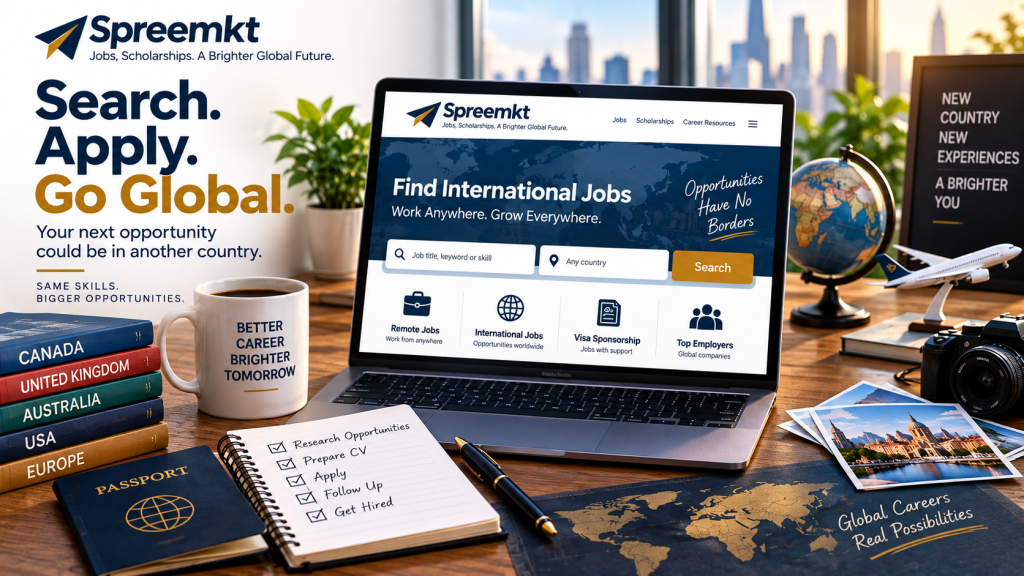
How to Find International Job Opportunities
There is no single website containing every international job opportunity.
Successful candidates usually combine several approaches.
Instead of relying entirely on large job boards, search through employer career pages, professional networks, government employment portals, recruitment agencies, industry communities, and specialized international job websites.
Here are some of the most effective methods.
1. Decide Which Countries You Want to Work In
One common mistake people make when searching for international jobs is applying everywhere without having a clear strategy.
You may search for:
Jobs abroad
and immediately start sending applications to employers in Canada, Germany, Australia, the United Kingdom, the United States, the Netherlands, and dozens of other countries.
This approach can become inefficient.
Every country has different immigration policies, employment requirements, skills shortages, professional licensing rules, salary expectations, and recruitment practices.
Start by choosing approximately two to four target countries.
Your decision should consider factors such as:
- Demand for your occupation
- Work visa options
- Language requirements
- Cost of living
- Average salaries
- Employment opportunities
- Recognition of your qualifications
- Possibility of permanent residence
- Relocation costs
- Professional licensing requirements
For example, someone working in healthcare should investigate countries experiencing shortages in their specific healthcare profession.
A software engineer may focus on countries with large technology industries and companies that recruit internationally.
A construction professional could investigate markets experiencing infrastructure expansion or shortages of qualified tradespeople.
International job searching becomes much easier when you stop searching the entire world and start targeting specific labour markets.
2. Identify Countries Where Your Skills Are in Demand
Your chances of finding an international job can improve when your occupation is difficult to fill locally.
Governments regularly adjust immigration programmes according to labour-market conditions.
Some countries publish information about occupations experiencing shortages or sectors where employers need additional workers.
Common fields that frequently appear in international recruitment include:
- Healthcare
- Information technology
- Software development
- Cybersecurity
- Engineering
- Construction
- Skilled trades
- Education
- Agriculture
- Hospitality
- Logistics
- Manufacturing
- Finance
- Scientific research
However, never assume that an occupation automatically qualifies you for immigration.
Requirements change.
Always verify your occupation and immigration route through the official government website of the country you are considering.
Ask yourself:
Which countries currently need people with my exact skills?
That question produces a much more focused job search than simply asking which country has jobs.
3. Search for Jobs That Specifically Mention Visa Sponsorship
If you require a work visa, identifying employers willing to sponsor international employees can save considerable time.
Use specific search phrases rather than generic terms.
Examples include:
“visa sponsorship jobs”
“jobs with visa sponsorship”
“international applicants welcome”
“relocation assistance jobs”
“work permit sponsorship”
“foreign worker jobs”
“skilled worker sponsorship jobs”
You can combine these phrases with your occupation.
For example:
“software engineer visa sponsorship UK”
“nursing jobs Canada international applicants”
“construction jobs Australia visa sponsorship”
“data analyst relocation assistance Germany”
“care assistant visa sponsorship UK”
“engineering jobs Canada foreign workers”
You can also search for specific technologies or qualifications.
For example:
“AWS engineer visa sponsorship”
or:
“ACCA jobs with sponsorship UK”
The more specific your search query becomes, the easier it can be to eliminate irrelevant vacancies.
4. Use Major International Job Websites
Large job platforms can provide access to thousands of vacancies from employers around the world.
Instead of browsing randomly, use filters.
Filter opportunities by:
- Country
- City
- Industry
- Experience level
- Salary
- Remote availability
- Employment type
- Date posted
Where available, create job alerts.
For example, you could create alerts for:
Business Development Manager — London
Software Engineer — Toronto
Registered Nurse — Australia
Cybersecurity Analyst — Germany
Receiving alerts helps you discover new vacancies soon after they are published.
This matters because popular international vacancies can attract large numbers of applications.
However, do not depend entirely on job boards.
Use them as one part of your strategy.
5. Search Company Career Pages Directly
One of the most effective ways to find international opportunities is also one of the most overlooked:
Search employers directly.
Large companies often publish vacancies on their own websites before or alongside third-party job platforms.
Start by creating a list of companies in your target industry.
Suppose you are looking for fintech employment.
Instead of searching only:
fintech jobs abroad
identify fintech companies operating in your target country.
Then visit each company’s careers page.
Look for sections such as:
- Careers
- Jobs
- Vacancies
- Join Us
- Opportunities
- Global Careers
- Open Positions
Search the vacancies for your profession.
This strategy can also help you determine whether the organization operates internationally.
A company with offices across several countries may be more accustomed to international recruitment than a small organization operating entirely within one local market.
6. Research Employers That Have Previously Sponsored Foreign Workers
Previous international hiring can be a useful research signal.
If an employer has recruited foreign professionals before, it may already understand the administrative processes involved.
That does not mean the employer will sponsor every vacancy.
However, it can help you prioritize your research.
Depending on the destination country, government databases, sponsor registers, immigration resources, job advertisements, company announcements, and employee profiles may provide useful information.
You can also search:
“[Company Name] visa sponsorship”
or:
“[Company Name] international employees”
Research the company’s current vacancies afterward.
The objective is not to send applications to every company that has ever employed someone internationally.
The objective is to create a shortlist of organizations where international recruitment appears realistic.
7. Use LinkedIn Strategically for International Jobs
LinkedIn can be extremely useful for international job searches because it combines job listings, professional networking, recruiters, employees, and company information.
But simply creating an account and clicking Easy Apply repeatedly is unlikely to maximize its value.
Optimize your profile first.
Your headline should clearly communicate your professional value.
Instead of:
Looking for opportunities
use something closer to:
Business Development Manager | B2B Sales | Client Acquisition | Partnership Development
Your profile should clearly explain:
- What you do
- Your professional experience
- Important accomplishments
- Technical skills
- Certifications
- Industry experience
- Relevant projects
Use measurable achievements where appropriate.
Instead of:
Responsible for sales.
write:
Managed B2B sales pipeline across multiple markets and developed new client acquisition partnerships.
Where you can truthfully quantify your results, include the numbers.
Recruiters need to understand your value quickly.
8. Connect With International Recruiters
Recruiters can help you discover opportunities that you may never find through normal job searches.
Search for recruiters specializing in:
- Your profession
- Your industry
- Your target country
- International recruitment
- Global mobility
- Foreign worker recruitment
Suppose you are an engineer looking for opportunities in Canada.
Search professional networks for phrases such as:
Engineering recruiter Canada
or:
Technical recruiter Toronto
Do not immediately send a message saying:
Please give me a job.
Instead, introduce yourself professionally.
A better message could be:
Hello Sarah, I’m a mechanical engineer with six years of experience in manufacturing and maintenance. I’m currently exploring opportunities in Canada and noticed that you recruit engineering professionals. I’d be glad to connect and follow the roles you share.
Short, specific messages usually create a better first impression than lengthy requests.
9. Build Relationships Before Asking for Referrals
Networking is not simply asking strangers for jobs.
Good professional networking involves building genuine relationships.
Follow professionals in your industry.
Engage thoughtfully with relevant posts.
Join discussions.
Share useful insights.
Connect with employees at companies you are interested in.
Over time, some of these relationships may provide information about vacancies, hiring processes, or referrals.
For example, imagine you want to work for a particular technology company in Ireland.
Search for people working there in your profession.
Instead of asking:
Can you refer me?
start with something specific:
Hi David, I noticed you work in cloud engineering at XYZ. I’m researching cloud engineering opportunities in Ireland and would appreciate hearing about the technical skills your team typically values.
This creates a professional conversation rather than an immediate transaction.
10. Join Professional Associations
Professional associations can provide access to:
- Industry events
- Job boards
- Conferences
- Training
- Networking opportunities
- Professional certifications
- Mentorship
- Employer connections
Some associations operate internationally.
If you work in engineering, accounting, project management, marketing, healthcare, information technology, architecture, finance, or another established profession, investigate relevant professional bodies.
Membership alone will not guarantee employment.
The value often comes from participating in the professional community.
Attend events.
Join webinars.
Contribute to discussions.
Connect with members.
International opportunities sometimes emerge through professional relationships rather than traditional job applications.
11. Attend Virtual International Career Fairs
You do not necessarily need to travel abroad to meet international employers.
Virtual career fairs have made international recruitment more accessible.
Employers, universities, government organizations, recruitment agencies, and professional associations sometimes organize online career events.
These events may allow candidates to:
- Speak with recruiters
- Attend employer presentations
- Submit CVs
- Participate in interviews
- Learn about immigration requirements
- Discover shortage occupations
European jobseekers, for example, can find cross-border employment resources and employment events through EURES.
Before attending a virtual career fair, research participating companies.
Prepare a short professional introduction.
Have an updated CV available.
Identify specific positions you want to discuss.
Do not attend simply to ask:
Are you hiring?
A stronger question might be:
I noticed your company is recruiting electrical engineers for its renewable energy projects. Do those positions accept applicants who currently live outside the country?
Specific questions make conversations more productive.
12. Use Government Employment Portals
Government employment websites are often overlooked.
Depending on the country, official government platforms may provide information about:
- Job vacancies
- Labour shortages
- Immigration programmes
- Work permits
- Employer sponsorship
- Qualification requirements
- Employment standards
- Foreign worker programmes
These sources can be especially useful because international employment involves both recruitment and immigration.
A job advertisement alone does not determine whether you are legally eligible to work in a country.
Always verify immigration information through the relevant government authority.
Never depend entirely on social media posts, recruitment advertisements, or immigration blogs for legal requirements.
13. Use EURES for European Opportunities
If your international job search involves Europe, EURES can be an important resource.
EURES is the European Employment Services network.
It provides jobseekers with resources relating to employment and mobility across participating European countries.
Services include job matching, career guidance, CV support, labour-market information and information relating to living and working abroad.
For candidates interested in European opportunities, resources like EURES can complement private job platforms.
However, immigration eligibility differs depending on your nationality and destination.
Always check whether you require a visa or work authorization.
14. Work With Reputable International Recruitment Agencies
Recruitment agencies can connect employers with qualified candidates.
Some specialize in international recruitment.
Others specialize in particular sectors such as:
- Healthcare
- Construction
- Engineering
- IT
- Education
- Hospitality
- Finance
- Logistics
Before working with an agency, investigate it carefully.
Check:
- Company registration where appropriate
- Physical address
- Official website
- Professional profiles
- Reviews
- Employer relationships
- Recruitment history
Be especially cautious when someone demands large upfront payments in exchange for a guaranteed job.
Legitimate recruitment arrangements vary by jurisdiction, but guaranteed employment claims should always be treated carefully.
Never send money or sensitive documents simply because someone claims to represent an international employer.
Verify independently.
15. Learn How to Identify International Job Scams
The desire to work abroad can make jobseekers targets for scammers.
International employment scams can appear convincing.
Fraudsters may create fake company websites, offer letters, recruiter profiles, email addresses, and immigration documents.
Common warning signs include:
Guaranteed employment
No legitimate recruiter can reasonably guarantee that you will receive a job without an appropriate selection process.
Unprofessional communication
Poor grammar alone does not prove fraud, but suspicious email domains, inconsistent company information, and unusual communication methods deserve investigation.
Requests for unusual payments
Be cautious when recruiters request money for interviews, employment guarantees, or suspicious processing fees.
Unrealistic salaries
If a relatively basic position offers compensation far above the normal market rate, investigate carefully.
No proper interview
Receiving a lucrative international job offer without a meaningful interview or assessment can be suspicious.
Pressure to act immediately
Scammers frequently create urgency.
They may tell you that you must pay within hours or lose the opportunity.
Do not allow urgency to prevent verification.
Requests for sensitive information
Be careful about providing passport details, banking information, identity documents, or other sensitive information before verifying who you are dealing with.
Whenever possible, confirm vacancies through the employer’s official careers page.
16. Create an International-Standard CV
Your CV is one of the most important parts of your international job search.
However, there is no single universal international CV format.
Expectations differ between countries.
A CV suitable for one country may need adjustments before being submitted elsewhere.
In general, your CV should be:
- Easy to read
- Professionally formatted
- Relevant to the vacancy
- Focused on achievements
- Free from unnecessary information
- Adapted to the target market
Typical sections include:
Name and contact information
Professional summary
Work experience
Education
Technical skills
Certifications
Relevant projects
Your professional experience should emphasize achievements rather than simply listing responsibilities.
Instead of:
Responsible for customer acquisition.
consider:
Developed and managed client acquisition initiatives across digital and direct sales channels.
When you have verifiable figures, use them.
For example:
Increased qualified leads by 35% within six months through targeted B2B acquisition campaigns.
Specific accomplishments make your experience easier to evaluate.
17. Tailor Your CV for Every Important Application
Sending exactly the same CV to hundreds of companies may seem efficient.
It often reduces relevance.
Employers hire for specific problems.
Your CV should demonstrate why your background matches the position being advertised.
Before applying, read the job description carefully.
Identify:
- Core responsibilities
- Required experience
- Technical skills
- Certifications
- Industry knowledge
- Preferred qualifications
Then make sure relevant experience appears clearly in your CV.
This does not mean copying the entire vacancy into your document.
It means presenting your genuine experience using terminology that accurately matches the role.
If a vacancy repeatedly emphasizes:
stakeholder management
and stakeholder management is genuinely part of your experience, your CV should make that visible.
18. Understand Applicant Tracking Systems
Many medium and large employers use applicant tracking systems, commonly called ATS platforms, to manage applications.
This means your CV should be easy for both software and humans to understand.
Use straightforward section headings such as:
- Professional Experience
- Education
- Skills
- Certifications
Avoid unnecessarily complicated layouts when applying through online recruitment systems.
Keywords also matter.
If an employer asks for experience with:
- Salesforce
- Business development
- B2B sales
- CRM management
- Lead generation
and you genuinely possess those skills, they should be represented clearly in your application.
Do not stuff keywords into your CV.
Use them naturally and accurately.
19. Write a Strong Cover Letter
Not every employer requires a cover letter.
When one is requested, avoid sending a generic letter.
A useful cover letter should explain:
- Why you are interested in the position
- Why your experience is relevant
- What you can contribute
- Why the organization interests you
If you are applying internationally, you can briefly clarify your location and work authorization situation where appropriate.
For example:
I am currently based outside the UK and am interested in opportunities open to international applicants requiring Skilled Worker sponsorship.
This prevents unnecessary confusion later in the process.
Keep your cover letter focused.
The purpose is not to repeat every detail from your CV.
It should connect your experience to the employer’s needs.
20. Optimize Your LinkedIn Profile for Recruiter Searches
Recruiters frequently search for candidates using keywords.
Your LinkedIn profile should contain terms associated with your profession.
For example, a digital marketing professional might include:
- Google Ads
- Meta Ads
- PPC
- Lead generation
- Conversion optimization
- Google Analytics
- Marketing strategy
A software developer could include:
- JavaScript
- React
- Python
- AWS
- APIs
- DevOps
Your headline, About section, experience, skills, and certifications should collectively communicate your expertise.
Do not fill your profile with unrelated keywords.
Focus on terms genuinely associated with your experience and the roles you want.
21. Create a Professional Portfolio
For some professions, a portfolio can significantly strengthen an application.
Examples include:
- Software development
- Graphic design
- UX/UI design
- Digital marketing
- Architecture
- Content writing
- Photography
- Data analytics
- Product management
Your portfolio should demonstrate what you have actually done.
A digital marketer could present campaigns, strategy, advertising results, landing pages, and analytics.
A developer might showcase applications, GitHub projects, technical documentation, or open-source contributions.
A designer might present case studies explaining the challenge, design process, and final solution.
International employers may not know your previous organizations.
A portfolio provides direct evidence of your abilities.
22. Search for Remote International Jobs
Relocation is not the only route to an international career.
Many organizations employ people across borders remotely.
Remote international work can help you:
- Build international experience
- Earn foreign-currency income
- Develop global professional networks
- Work with multinational teams
- Strengthen your CV
Search using terms such as:
remote worldwide
remote EMEA
remote international
work from anywhere
global remote jobs
Read location restrictions carefully.
“Remote” does not always mean “work from any country.”
A company may advertise a remote role that is available only to people living in a particular country because of tax, employment, security, or regulatory requirements.
Always confirm eligibility before applying.
23. Consider Multinational Companies in Your Home Country
Sometimes the easiest route to an international career begins locally.
Multinational companies often operate offices across many countries.
Working for one in your home country may eventually provide opportunities for:
- International projects
- Overseas assignments
- Regional responsibilities
- Internal vacancies
- Intra-company transfers
This route can be particularly valuable for professionals who have strong experience but find direct international sponsorship difficult.
Once you are already employed within an international organization, you may gain access to internal vacancies unavailable to external candidates.
There is no guarantee of relocation, but it can create another pathway.
24. Consider International Graduate Programmes
Students and recent graduates should investigate multinational graduate programmes.
Large organizations sometimes recruit graduates into structured programmes involving:
- Training
- Rotations
- Mentorship
- International assignments
- Leadership development
Eligibility requirements vary significantly.
Some programmes accept international applicants while others require existing work authorization.
Read the eligibility criteria carefully before applying.
Applications may open months before the programme starts, so early preparation matters.
25. Consider Internships and Research Opportunities
International internships can provide valuable experience for students and early-career professionals.
Universities, multinational organizations, NGOs, research institutes, technology companies, development organizations, and international institutions may offer internships.
Academic candidates should also explore:
- Research assistantships
- PhD positions
- Postdoctoral opportunities
- University employment
- Research fellowships
These opportunities may have different immigration processes from conventional corporate employment.
Always check the conditions attached to the particular programme.
26. Improve Skills That International Employers Need
International employers rarely hire someone simply because that person wants to relocate.
They hire because the candidate can solve a business problem.
Ask:
What makes me worth recruiting internationally?
Your competitive advantage might be:
- Specialized technical knowledge
- Industry experience
- Professional certifications
- Language skills
- Management experience
- Experience in emerging markets
- Knowledge of a particular technology
- Proven sales performance
- Research expertise
- Rare professional qualifications
If you repeatedly see the same requirement in international vacancies and you do not have that skill, consider developing it.
Your job search should therefore include both applications and skill development.
27. Obtain Internationally Recognized Certifications Where Relevant
Professional certifications can sometimes make your experience easier for international employers to evaluate.
The appropriate certification depends on your field.
Certifications are common in areas such as:
- Project management
- Cloud computing
- Cybersecurity
- Accounting
- Digital marketing
- Data analytics
- Networking
- Human resources
- Engineering
However, do not collect certificates simply for the sake of having certificates.
Prioritize qualifications employers actually request.
Review 30–50 vacancies for your target role.
Write down the qualifications that appear repeatedly.
That gives you evidence about what the market values.
28. Research Professional Licensing Requirements
Some occupations are regulated.
Having years of experience in your home country does not necessarily mean you can immediately practise the same profession elsewhere.
Regulated occupations may include certain:
- Healthcare professions
- Legal professions
- Engineering roles
- Teaching positions
- Financial occupations
- Skilled trades
You may need:
- Credential assessment
- Professional registration
- Examinations
- Language tests
- Additional training
- Supervised practice
Investigate these requirements before spending months applying for jobs.
Otherwise, you may discover that you are professionally qualified but not yet legally authorized to practise the occupation in your destination.
29. Improve Your Language Skills
Language proficiency can determine whether you qualify for certain jobs.
English is widely used internationally, but many countries and employers require other languages.
For example, an employer may expect proficiency in the country’s primary working language even when the technical role itself can partly be performed in English.
Read vacancy requirements carefully.
Where language proficiency is required, improving it can expand your employment options considerably.
Language ability may also affect immigration eligibility depending on the country and immigration programme.
30. Understand Work Visa Requirements Before Applying
Do not wait until you receive an offer before learning how the immigration process works.
You do not need to become an immigration expert.
But you should understand the basics.
Research:
- Available work visa categories
- Sponsorship requirements
- Eligible occupations
- Salary thresholds where applicable
- Qualification requirements
- Language requirements
- Processing requirements
- Whether dependants can accompany you
- Whether the route can lead to permanent residence
Use official government immigration websites as your primary source.
Immigration policies can change.
An article or social media video published two years ago may no longer reflect current requirements.
31. Understand the Difference Between a Job Offer and a Work Visa
Receiving a job offer does not automatically give you permission to work in another country.
Employment and immigration are connected but separate processes.
Depending on the country, an employer may need to:
- Hold sponsorship authorization
- Complete labour-market requirements
- Issue supporting documentation
- Meet salary conditions
- Provide employment details
You may then need to submit your own visa or work permit application.
Do not resign from your current job, purchase flights, or make irreversible relocation decisions solely because you have received an informal employment message.
Confirm the employment offer and understand the immigration process first.
32. Prepare for International Interviews
International interviews are frequently conducted online.
Before your interview:
- Test your internet connection
- Test your microphone
- Check your camera
- Find a quiet environment
- Research the company
- Review the job description
- Prepare examples of your achievements
- Understand the time-zone difference
You should be ready to answer questions such as:
Why do you want to work in this country?
Why are you interested in our company?
Do you require visa sponsorship?
When could you relocate?
What experience do you have working across cultures?
Answer honestly.
If you require sponsorship, do not pretend otherwise.
Work authorization will eventually need to be addressed.
33. Prepare for Time-Zone Differences
International recruitment often involves interviews with people in different time zones.
Always confirm the interview time carefully.
If an invitation says:
2:00 PM London time
do not assume it means 2:00 PM where you live.
Use a reliable time-zone converter.
Also remember that daylight-saving changes can affect time differences during different parts of the year.
Missing an interview because of a time-zone misunderstanding creates an avoidable negative impression.
34. Research International Salary Levels
Before discussing salary, understand the market.
Research:
- Typical salary for your occupation
- Salary differences between cities
- Taxes
- Housing costs
- Transportation
- Healthcare expenses
- Pension contributions
- Cost of living
A salary that appears extremely high when converted into your local currency may be ordinary in the destination country.
For example, earning the equivalent of several million naira per month sounds substantial from a Nigerian perspective.
But if the job is located in an expensive international city, rent, taxes, transport, insurance, and other expenses may significantly change the picture.
Evaluate compensation within the local economic context.
35. Do Not Apply Only to Famous Companies
Global brands attract enormous numbers of applicants.
There is nothing wrong with applying to them.
But your international job strategy should also include:
- Medium-sized companies
- Growing startups
- Regional employers
- Specialist firms
- Companies outside major capital cities
These organizations may have less competition for certain positions.
Some may also struggle to recruit specialized skills locally.
Build a broad employer list rather than applying only to companies everyone recognizes.
36. Track Every International Job Application
International job searching can quickly become confusing.
Create a spreadsheet containing:
- Company name
- Position
- Country
- Application date
- Vacancy URL
- Recruiter
- Visa sponsorship status
- Interview date
- Application status
- Follow-up date
This prevents duplicate applications and helps you identify patterns.
For example, after 50 applications you may notice that applications in one country generate significantly more responses than another.
That information can help you refine your strategy.
37. Measure Your Job Search Like a Process
Do not judge your international job search entirely by whether you have received an offer yet.
Track your conversion rates.
For example:
100 applications
↓
15 recruiter responses
↓
8 interviews
↓
3 final-stage interviews
↓
1 offer
If you receive almost no responses after dozens of carefully targeted applications, investigate your CV, role selection, experience level, location restrictions, and sponsorship requirements.
If you receive interviews but consistently fail to progress, focus more on interview preparation.
This turns frustration into information.
38. Prioritize Quality Applications Over Mass Applications
Submitting 500 applications does not automatically make you more competitive.
Twenty carefully targeted applications may outperform hundreds of random applications.
Before applying, ask:
- Do I meet most core requirements?
- Is the position open to candidates in my location?
- Does the employer appear to recruit internationally?
- Is sponsorship available if I require it?
- Does my CV clearly demonstrate relevant experience?
If the answers are mostly yes, invest time in the application.
39. Follow Up Professionally
Following up can be appropriate after submitting an application or completing an interview.
Keep your message brief.
For example:
Hello [Name], I’m following up regarding my application for the [Position] role submitted on [Date]. I remain very interested in the opportunity and would be happy to provide any additional information required. Thank you for your consideration.
Avoid messaging recruiters every day.
Professional follow-up shows interest.
Excessive follow-up can have the opposite effect.
40. Build an International Personal Brand
Your online presence can support your international job search.
Share professional content related to your industry.
You might discuss:
- Industry trends
- Projects
- Lessons from your work
- Case studies
- Technical insights
- Career development
- Professional events
This can make your expertise more visible.
It also gives recruiters something meaningful to see when they search your name.
You do not need thousands of followers.
You need a credible professional presence.

Your ideal platform depends on your profession and destination.
Rather than relying on one website, combine several sources.
Professional networking platforms
Useful for job discovery, recruiter outreach, networking, and employer research.
Employer career websites
Useful for identifying vacancies directly from the hiring organization.
Government job portals
Useful for official employment information and sometimes verified vacancies.
International recruitment agencies
Useful when recruiters specialize in your occupation.
Professional associations
Useful for specialized jobs and networking.
University career portals
Useful for students, researchers, academics, and recent graduates.
Remote job platforms
Useful for candidates who want international experience without immediate relocation.
International mobility networks
Useful when searching across multiple countries or regions.
Best Countries to Consider for International Jobs
There is no universally “best” country for international workers.
The right destination depends on your occupation, experience, qualifications, language ability, financial situation, immigration eligibility, and career objectives.
However, several destinations frequently attract international jobseekers.
Finding Jobs in Canada
Canada is a popular destination for international workers because of its large immigrant population and multiple economic immigration pathways.
Candidates should research both federal and provincial requirements.
Jobseekers should also investigate:
- Whether their occupation is regulated
- Provincial employment opportunities
- Employer requirements
- Work permit options
- Credential recognition
Do not assume every Canadian job advertisement accepts foreign applicants.
Check eligibility carefully.
Finding Jobs in the United Kingdom
The United Kingdom attracts international professionals across industries including healthcare, technology, engineering, finance, education, and professional services.
Candidates requiring sponsorship should understand the relevant work visa route and employer requirements.
Some employers can sponsor qualifying international workers while others cannot.
Research the employer and immigration requirements before applying.
Finding Jobs in Australia
Australia is another major destination for skilled professionals.
Opportunities vary according to occupation, location, employer demand, and immigration policy.
Before applying, investigate:
- Occupation requirements
- Skills assessments
- Registration requirements
- Visa pathways
- Employer sponsorship
- English-language requirements where applicable
Use official Australian government information for immigration decisions.
Finding Jobs in the United States
The United States has one of the world’s largest labour markets, particularly in areas such as technology, healthcare, finance, engineering, research, entertainment, and professional services.
However, work authorization can be complex.
Different visa categories apply to different circumstances.
Candidates should research their potential immigration pathway before assuming an employer can sponsor them.
International students already studying in the United States may also have different employment options from applicants living overseas.
Finding Jobs in Europe
Europe contains many different labour markets.
Do not treat Europe as one country.
Employment demand, languages, immigration rules, salaries, and work cultures differ considerably between countries.
Potential destinations may include:
- Germany
- Ireland
- Netherlands
- France
- Sweden
- Denmark
- Finland
- Portugal
- Spain
- Austria
- Belgium
Research countries individually.
EURES can also provide employment and mobility information for participating European markets.
How Nigerians Can Find International Job Opportunities
For Nigerian professionals, international job searching should begin with skills rather than relocation.
Instead of asking:
Which country can I move to?
start with:
Which international employers need my skills?
This shift matters.
If you are a Nigerian software engineer, nurse, accountant, digital marketer, engineer, salesperson, project manager, data analyst, researcher, technician, or skilled tradesperson, investigate where your experience is in demand.
Then determine:
- Whether employers recruit internationally.
- Whether your qualifications are recognized.
- Whether your occupation requires licensing.
- Whether a viable work visa exists.
- Whether employers sponsor that type of position.
Prepare your CV for the destination market.
Strengthen your LinkedIn profile.
Create a portfolio where appropriate.
Connect with recruiters.
Apply directly to employers.
Most importantly, verify immigration information through official government channels rather than depending solely on social media.
Common Mistakes When Searching for Jobs Abroad
International jobseekers often repeat several mistakes.
Applying without reading eligibility requirements
Some vacancies clearly state that applicants must already have permission to work in the country.
Applying anyway may waste your time.
Using one generic CV
Your application should reflect the requirements of the position.
Focusing only on visa sponsorship
Employers primarily want skills.
Sponsorship is a mechanism enabling them to employ you, not the value you offer.
Lead with professional value.
Paying questionable agents
Never assume payment guarantees employment.
Verify recruiters and employers independently.
Ignoring professional licensing
A job may require registration before you can practise.
Ignoring language requirements
Technical competence may not compensate for required language proficiency.
Applying only through job boards
Combine job boards with networking, recruiters, career pages, professional associations, and official employment resources.
Giving up too early
International recruitment can take longer than local recruitment.
A structured process and consistent improvement are essential.
Step-by-Step International Job Search Strategy
If you want a practical system, follow this sequence.
Step 1: Choose your target occupation
Define the exact roles you want.
Step 2: Select two to four target countries
Research demand and immigration requirements.
Step 3: Research visa pathways
Understand whether sponsorship or another form of work authorization is required.
Step 4: Identify 50–100 target employers
Include large, medium-sized, and growing companies.
Step 5: Optimize your CV
Adapt it to your target profession and country.
Step 6: Optimize your LinkedIn profile
Include relevant skills, achievements, and keywords.
Step 7: Build evidence of your skills
Create a portfolio, certifications, case studies, or projects where appropriate.
Step 8: Create job alerts
Monitor new opportunities.
Step 9: Network with professionals
Connect with recruiters and employees in your industry.
Step 10: Apply consistently
Prioritize relevant vacancies rather than random applications.
Step 11: Track your applications
Record responses and interview outcomes.
Step 12: Improve based on results
Adjust your strategy when necessary.
Frequently Asked Questions About Finding International Jobs
How can I find international job opportunities?
You can find international job opportunities through employer career pages, job platforms, government employment portals, professional networks, recruitment agencies, career fairs, professional associations, and referrals.
Combining several channels is generally more effective than relying on one source.
How can I find jobs abroad with visa sponsorship?
Search specifically for vacancies mentioning terms such as “visa sponsorship,” “international applicants,” “relocation assistance,” or the relevant work visa.
You should also research employers that are legally able to sponsor foreign workers where the destination country operates a sponsorship system.
Can I get an international job without experience?
It is possible, but your options may be narrower.
Recent graduates can investigate graduate schemes, internships, entry-level positions, research opportunities, seasonal work, and organizations that recruit internationally.
Building relevant skills, projects, internships, certifications, and professional connections can strengthen your application.
Can I apply for jobs abroad from Nigeria?
Yes.
Many employers accept online applications from international candidates.
However, whether you can ultimately work in the destination country depends on the employer, position, immigration requirements, qualifications, and work authorization process.
Which countries offer jobs to foreigners?
Many countries employ foreign workers, but the rules differ considerably.
Common destinations include Canada, the UK, Australia, the United States and several European countries.
Rather than choosing a country based only on popularity, investigate where your occupation is in demand and whether you have a realistic immigration pathway.
How do I know whether a foreign job is legitimate?
Verify the vacancy through the employer’s official website.
Research the recruiter.
Check email domains carefully.
Be cautious about guaranteed employment, unusual payment requests, unrealistic salaries, and job offers made without proper interviews.
For immigration requirements, verify information using official government sources.
Do international companies pay for relocation?
Some do.
Relocation packages may include flights, temporary accommodation, moving expenses, immigration assistance, or other benefits.
Others provide only visa sponsorship.
Some provide no relocation assistance at all.
Check the employment package rather than assuming relocation costs are covered.
What documents might I need when applying for jobs abroad?
Requirements vary, but you may eventually need documents such as:
- Passport
- CV or résumé
- Academic certificates
- Professional qualifications
- Employment references
- Portfolio
- Professional registration
- Language-test results
- Police or medical documentation during certain immigration processes
Do not submit sensitive documents unnecessarily during early-stage applications.
How long does it take to get an international job?
There is no fixed timeframe.
It depends on your profession, experience, target country, employer, immigration requirements, labour demand, and job-search strategy.
Some candidates secure opportunities quickly.
Others search for months.
Focus on improving the quality of your applications rather than relying on a particular timeline.
Final Thoughts: Finding an International Job Requires a Strategy
Finding international job opportunities is not simply about sending your CV to hundreds of foreign companies.
A successful international job search requires research.
You need to understand where your skills are needed, which employers recruit internationally, what immigration requirements apply, and how to present your experience competitively.
Start with a small number of target countries.
Identify employers that hire people with your skills.
Create a professional CV.
Optimize your LinkedIn profile.
Build relationships with recruiters and professionals.
Use job boards, government resources, employer websites, professional associations, and recruitment agencies together.
Most importantly, focus on the value you can provide.
An international employer is not hiring you simply because you want to move abroad.
They are hiring because your skills, experience, knowledge, or potential can help their organization.
When your job search communicates that value clearly, you move from simply searching for jobs abroad to competing seriously for international opportunities.
The process may take time, but every targeted application, new professional connection, improved skill, and interview gives you more information about the market.
Treat your international job search like a career project.
Research carefully.
Apply strategically.
Track your progress.
Improve continuously.
And before making any employment, immigration, or relocation decision, verify the requirements through the relevant employer and official government authorities.
That approach gives you a much stronger foundation for turning an international job search into a genuine global career opportunity.